Whether you are building a classroom robotics demo, a home-made smart car, or a compact project vehicle for Arduino and Raspberry Pi, a 4WD chassis with reliable motors makes setup smoother and experimentation more flexible. This guide highlights five popular 4 wheel drive kits and components that pair well with DIY robotics, autonomous navigation, and motion control experiments. Each item is evaluated for durability, ease of use, and versatility across voltage ranges and control systems.
| Product | Brand | Notes |
|---|---|---|
| 4 Sets TT Motor with Leads, DC 3-6V Gearbox Motor Dual Shaft 200RPM Ratio 1:48 Motor with Tire Wheel Kit for Arduino DIY Smart Car Robot | Unknown | High rpm range, versatile voltage, dual shaft motors |
| 4WD Robot Car Chassis Kit with TT Motor, Battery Box, Acrylic Chassis and 4 Wheels | YonPhsy Store | Sturdy acrylic chassis, encoder discs included |
| Robot Motor Kit DC Motor 3-6V Gear TT Motor with Tire Wheel + L293D Drive Controller | ALAMSCN Store | 4 DC motors, control board included, duPont cables |
| POSTACK 24 Volt Ride on Car with Parental Remote Control | POSTACK Store | 4WD ride-on vehicle, remote control mode |
| 2Pack 24V RS555 12000RPM High Torque Drive Motor Gearbox for Power Wheels | JRRXM Store | High-speed motors, gearbox upgrade parts |
The following sections detail five selected products, highlighting key features and how they fit into a driving project with common microcontrollers and logic boards. Each entry includes a direct link to the product page for quick access.
4 Sets TT Motor With Leads And Wheel Kit
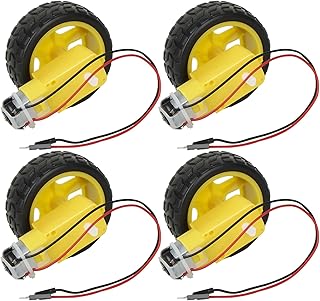
The TT DC gearbox motor set provides a compact, versatile option for Arduino-based smart car projects. With a 1:48 gear ratio, these motors yield reliable power outputs suitable for wheel-driven rovers and small bots. Their voltage range spans 3-6V, allowing operation across common microcontroller power supplies. Speed and torque are suitable for educational robotics, enabling responsive but controllable motion. The dual-shaft configuration simplifies mounting and wheel alignment, while the included wheel kit supports rapid prototyping of drive systems. This set is well-suited for projects that require straightforward motor integration with modest torque needs.
4WD Robot Car Chassis Kit With TT Motor And Encoder Discs

This 4WD chassis kit includes four TT motors, a transparent two-layer acrylic frame, and four rubber-tread wheels for traction on flat or smooth surfaces. The four encoder discs enable speed measurement and basic motion control experiments, making it a strong choice for learning trajectory tracking, motor calibration, and basic autonomous navigation. The acrylic construction provides a clean appearance and modular mounting for sensors and controllers, while the four-wheel drive system ensures stable traction during experiments and demonstrations.
Robot Motor Kit With L293D Controller

This motor kit pairs four DC motors with a built-in L293D drive controller, facilitating straightforward Arduino and compatible board integration. The package typically includes four wheels, a drive chassis, and a set of DuPont cables for easy wiring. The controller supports common Arduino platforms, enabling simultaneous motor control and servo integration for more complex maneuvers. It is an accessible option for beginners and educators exploring motor control, PWM speed regulation, and basic autonomous behavior in a compact kit.
POSTACK 24 Volt Ride On Car with Remote

This entry diverges from typical DIY robot kits and focuses on a 24V ride-on vehicle designed for kids. It features four drive motors, a remote control option, and a range of safety features like a soft start, seat belt, and durable wheels. While not a traditional robotics module, understanding its drive system, power management, and control interfaces can be informative for comparing consumer ride-on engineering with DIY robot platforms. It also illustrates how motor strength and transmission choices influence performance on varied terrain and safety considerations for remote operation.
2Pack RS555 12000RPM High Torque Motors

These 24V RS555 motors deliver high RPM at up to 12,000, paired with a robust gearbox suitable for Power Wheels upgrades and ride-on toy conversions. The kit includes two motors, gearboxes, and several accessory components such as connectors and couplers. The materials emphasize durability, with steel gears and copper windings designed to boost torque and reliability over long operation. This option is ideal for projects requiring higher speed and torque while maintaining compatibility with standard 24V power sources often used in advanced robotic prototypes and heavy-duty toy enhancements.
Buying Guide: Key Purchase Considerations
- Voltage compatibility: Check motor voltage ranges (e.g., 3-6V vs 24V) to ensure compatibility with your controller and power supply.
- Torque and speed: Match gear ratios and motor RPM to your application’s traction, load, and desired acceleration. High torque is essential for climbing or heavy payloads, while higher RPM supports faster locomotion on smooth surfaces.
- Control interface: Determine whether you need an integrated motor driver (such as L293D) or a standalone motor kit that requires external controllers like Arduino, Raspberry Pi, or other microcontrollers.
- Mounting and hardware: Look for kits with clear mounting provisions, encoder options, and robust chassis materials (acrylic, metal, or composite) that suit your project’s durability and sensor integration needs.
- Encoders and feedback: Encoder discs enable speed sensing and closed-loop control. If precise motion is critical, prioritize encoder-enabled options and compatible libraries.
- Expansion potential: Consider future upgrades, such as additional motors, sensors, or control boards, and verify that the kit supports easy expandability.
- Safety and durability: For ride-on or high-torque setups, assess structural integrity, protective housings, and safety features like soft-start mechanisms and protective enclosures for electronics.
- Project goals: Align the chosen components with your learning objectives—basic motor control, autonomous navigation, sensor fusion, or remote operation—and select kits that provide appropriate documentation and community support.
Across these options, the common thread is modularity: kits that offer straightforward assembly, clear wiring, and scalable control pathways tend to deliver the most reliable learning and development experience. When evaluating options, consider both immediate project needs and longer-term goals to choose components that remain useful as your skills grow.