Choosing the right lower ball joint socket is essential for safe suspension work on modern vehicles. This guide highlights five reliable options commonly used for Chrysler, Dodge, Jeep, and GM applications, focusing on durability, fit, and ease of use. Each product section provides practical details to help you compare performance, durability, and compatibility with 1-59/64-inch or similar ball joints. Use the buying guide to balance affordability with tool reliability for your shop or home garage needs.
Summary of Selected Products
| Product | Brand | Key Feature | Fit Type |
|---|---|---|---|
| 40075 Lower Ball Joint Socket | Joes Racing Store | OEM-equivalent part number 40075 | Lower ball joints |
| 12073 – 1-59/64-Inch Ball Joint Socket | ARES Store | Heavy-duty CR-V alloy steel, black finish, unique broaching | Lower and upper ball joints, Chrysler/Dodge/Jeep |
| 10214 2-9/64-Inch Ball Joint Socket | Sunex Tools Store | 6-point design for max torque transfer | Chrysler/Dodge light trucks and vans |
| 13 PCS Spindle Nuts Socket Kit | Yuesstloo Store | 13 sizes, KM groove nuts compatibility | GM, Ford, GMC, Dodge applications |
| 12111 – 3-Piece Ball Joint Socket Set | ARES Store | Two socket sizes plus adapter and case | Chrysler/Dodge/Jeep |
JOES RACING PRODUCTS 40075 Lower Ball Joint Socket

The JOES Racing 40075 lower ball joint socket is designed as an OEM-equivalent part for dependable service in lower ball joint applications. It prioritizes compatibility with common automatic and manual suspension systems. The tool is compact for easy access in tight wheel wells and features standard specifications that align with many Chrysler, Dodge, and GM models. Construction emphasizes durability while maintaining a practical price point for frequent use in repair work.
ARES 12073 – 1-59/64-Inch Ball Joint Socket

ARES 12073 is a heavy-duty ball joint socket engineered to handle 1-59/64-inch joints on Chrysler, Dodge, and Jeep models. The tool is forged from heat-treated CR-V alloy steel and finished with black phosphate for corrosion resistance. A unique broaching design ensures a precise match with the collar on thread-on ball joints, reducing the risk of slippage during removal or installation. This socket excels in high-torque scenarios and provides reliable performance across multiple vehicle families.
SUNEX TOOLS 10214 2-9/64-Inch Ball Joint Socket

SUNEX 10214 offers a 3/4-inch drive 2-9/64-inch ball joint socket with a 6-point design for maximum contact with fastener flats. The six-point geometry improves torque transfer and reduces rounding under high-torque use. Crafted from chrome molybdenum alloy steel, this socket provides durability and resilience for heavy-duty aviation and automotive tasks, making it suitable for trucks and vans used in Chrysler/Dodge lineups.
13 PCS Spindle Nuts Socket Kit — KM Groove Nuts

This 13-piece spindle nuts kit includes sockets ranging from 22mm to 83.5mm with a 1/2-inch drive and 4-teeth exterior. It’s designed to remove 4-slot spindle nuts and is compatible with GM, Ford, GMC, Dodge, and other brands. The assortment covers a wide range of hub and bearing applications, making it a versatile choice for general automotive maintenance and wheel hub work. Ensure the outer diameter matches your vehicle’s axle nuts before use.
ARES 12111 – 3-Piece Ball Joint Socket Set
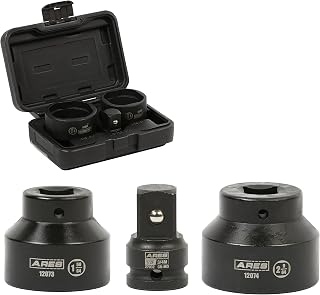
The ARES 12111 set provides two ball joint socket sizes (1-59/64-inch and 2-9/64-inch) plus a 1/2-inch female to 3/4-inch male adapter and a storage case. The sockets are built from heat-treated CR-V alloy steel with a black phosphate finish for durability and corrosion resistance. The included adapter increases versatility, letting you pair these sockets with standard 1/2-inch tools for broader compatibility across Chrysler, Dodge, and Jeep models that use different ball joint sizes.
Buying Guide: Key Purchase Considerations
- Ball joint size and compatibility: Confirm the target joint size (for example, 1-59/64-inch or 2-9/64-inch) and whether the socket supports both lower and upper joints on your vehicle family.
- Material and build quality: Look for forged CR-V or CR-MO alloy steel with protective finishes (such as black phosphate) to resist corrosion and withstand high torque.
- Socket design: A six-point or multi-point design provides better contact and torque transfer, reducing the risk of rounding fasteners in high-stress situations.
- Broaching and fit: Tools designed to match collar shapes on thread-on joints improve reliability and reduce tool slippage during installation or removal.
- Versatility: Some sets include adapters or multiple sizes, increasing utility across vehicle brands and models, including GM, Ford, Chrysler, Dodge, and Jeep.
- Storage and portability: A case or organized set helps keep sockets in one place, convenient for on-site use and transport between jobs.
- Brand reliability and warranty: Choosing established brands with clear part compatibility can provide peace of mind for frequent repair work.
- Intended use: Consider whether you primarily service light-duty trucks and vans or mid-size SUVs and passenger cars, as some sockets are tailored to specific platforms.
Practical Considerations and Usage Perspectives
- For professional repair shops, selecting a high-grade set with multiple sizes may reduce the need for additional purchases and downtime caused by missing sizes.
- Home garages benefit from versatile kits that cover common ball joint sizes and spindle nuts, increasing readiness for DIY projects without specialized tooling.
- When replacing ball joints, ensure the joint and socket combination matches the vehicle’s specifications to prevent cross-threading or improper seating.
- Always inspect tool surfaces for wear before use, especially the teeth and broaching areas that contact fasteners, to avoid damaging joints.
- Store tools in a dry environment to preserve finishes and prevent rust, extending the life of high-torque sockets used in suspension work.