Choosing a self-leveling trailer hitch can improve stability, steering control, and braking performance on highway rides and back roads. Below are five top options that balance weight distribution, sway control, and ease of installation. Each product is designed to help level the trailer tongue, reduce trailer sway, and provide a smoother towing experience across a range of vehicle types and trailer configurations.
| Product | Brand | Key Benefit | GTW / Tongue Weight |
|---|---|---|---|
| VEVOR Weight Distribution Hitch | VEVOR Store | Four-point sway control with wide compatibility | Up to 14,000 lbs GTW / 1,400 lbs tongue |
| CURT 17063 Weight Distribution Hitch | CURT Store | Integrated lubrication and sway control | 10,000 – 14,000 lbs GTW / 1,000 – 1,400 lbs tongue |
| TYT Adjustable Trailer Hitch Ball Mount | TYT Store | High versatility and simple setup | Up to 7,500 lbs trailer weight |
| Adjustable Trailer Hitch – TLVuvmo Aluminum Drop Hitch | TLVuvmo | Large drop/rise with heavy-duty capacity | Up to 18,500 lbs GTW |
| Kingfun Adjustable Trailer Hitch | Kingfun Store | Tri-ball system with adjustable height | Up to 12,500 lbs GTW |
These options cover a range of towing needs, from everyday light-to-medium trailers to heavy-duty rigs. The list emphasizes stability features, ease of installation, and compatibility with various hitch receivers. Review the features to pick the best fit for your vehicle and trailer configuration.
VEVOR Weight Distribution Hitch With Sway Control

The VEVOR system operates as a weight-distributing hitch rated for up to 14,000 lbs gross trailer weight and 1,400 lbs tongue weight. It includes a 2-5/16 inch hitch ball and a 2-inch shank. The four-point sway control uses friction to counter side-to-side movement for steadier highway performance. It is designed to work with many surge/brake actuators and V-nose trailers that some hitches cannot handle, while redistributing tongue weight to level the rig for improved steering and braking.
CURT 17063 Round Bar Wd Hitch With Sway

CURT’s 17063 model features integrated lubrication with two grease zerks for continuous lubrication, plus sway control for a smoother ride. The forged steel spring bars and a fabricated head deliver reliability for towing between 10,000 and 14,000 lbs gross trailer weight, with a tongue weight range of 1,000 to 1,400 lbs. The system aims to evenly distribute tongue weight to level the truck and trailer, improving handling and braking efficiency.
TYT Adjustable Trailer Hitch Ball Mount
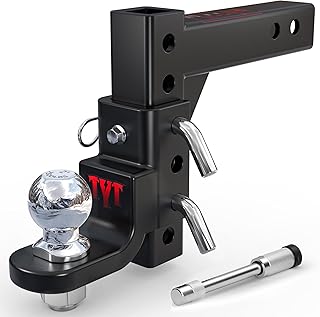
TYT offers a versatile 2-inch receiver ball mount with a 2-inch ball capable of up to 7,500 lbs gross trailer weight. The product emphasizes a simple, user-friendly installation, with a 9-1/2 inch drop and 8-1/4 inch rise to accommodate various trailer setups. A robust powder-coated finish and high-strength steel construction deliver durability in diverse weather and road conditions.
Adjustable Trailer Hitch – Aluminum Drop (TLVuvmo)

TLVuvmo’s aluminum drop hitch pairs a 2.5-inch receiver with a 8-inch drop/rise and a high tongue weight tolerance, supporting up to 18,500 lbs GTW. The chrome-plated steel balls available in multiple sizes provide flexibility for different trailer couplers. This hitch is designed for heavy-duty trucks and SUVs that require significant leveling to maintain trailer stability during towing.
Kingfun Adjustable Trailer Hitch With Tri-Ball

Kingfun offers a versatile tri-ball setup: 1-7/8″, 2″, and 2-5/16″ balls, enabling compatibility with a variety of trailers. The adjustable 6-inch rise/drop height helps align the trailer tongue with the hitch to reduce load sway and improve stability. Built from forged steel with a corrosion-resistant finish, this hitch emphasizes durability for frequent towing across different terrains and weather conditions.
Buying Guide: Key Considerations For Self Leveling Trailer Hitches
- Trailer weight capacity: Match GTW and tongue weight to your trailer and vehicle. Overestimating can affect handling and safety.
- Sway control features: Four-point sway control, integrated sway bars, and continuous lubrication systems help minimize side-to-side motion and noise.
- Weight distribution design: Effective weight distribution reduces tongue load on the tow vehicle, improving steering, braking, and stability.
- Compatibility: Check shank size, ball size, and receiver compatibility with your existing hitch setup.
- Durability and weather resistance: Look for forged steel or aluminum construction with corrosion-resistant coatings for longevity.
- Ease of installation: Some models offer straightforward installation with minimal tools, while others may require professional setup.
- Maintenance needs: Integrated lubrication systems reduce maintenance, but grease fittings should be checked regularly.
- Vehicle and trailer alignment: The ability to fine-tune rise/drop helps achieve level towing across varying terrains and loads.
- Warranty and support: Consider brands offering solid warranties and accessible customer support for long-term reliability.
- Budget vs. features: Weigh sway control, distribution efficiency, and build quality against price to find the best value.
Choosing the right self-leveling trailer hitch involves evaluating lifting capacity, sway suppression, and how easily the setup adapts to different trailers. The products listed provide options across a spectrum of vehicle types and trailer weights, prioritizing stability, ease of use, and durability for American roadways.